演讲嘉宾简介
Louis W. Pauly is the J. Stefan Dupré Distinguished Professor of Political Economy in the Department of Political Science of the University of Toronto, where he has served as Department Chair, Director of the Centre for International Studies, Acting Director of the Munk Centre, and Founding Director of the Centre for the Study of Global Japan in the Munk School of Global Affairs and Public Policy. He is a Senior Fellow of Massey College and a Fellow of Trinity College (Toronto). In 2015 he received the Distinguished Scholar Award in International Political Economy from the International Studies Association. He held the Canada Research Chair in Globalization and Governance in Toronto and was elected a Fellow of the Royal Society of Canada in 2011. He is a former editor of the journal International Organization. Early in his career, he served on the staff of the Royal Bank of Canada and the Policy Development and Review Department of the International Monetary Fund. He is a graduate of Cornell University, the London School of Economics and Political Science, New York University, and Fordham University. His publications include Insuring States in an Uncertain World: Towards the Collaborative Government of Complex Risks (Cambridge University Press, 2025) and many other books, journal articles, and book chapters.
路易斯·W·保利现任多伦多大学政治学系J·斯特凡·杜普雷政治经济学讲席教授,曾任该系系主任、国际研究中心主任、蒙克中心执行主任,以及蒙克全球事务与公共政策学院日本研究中心创始主任。他是梅西学院高级研究员与多伦多大学三一学院院士。2015年,他荣获国际研究协会颁发的国际政治经济学杰出学者奖。他曾担任多伦多大学全球化与治理加拿大研究讲席教授,并于2011年当选加拿大皇家学会院士。保利教授曾担任《国际组织》期刊主编。在职业生涯早期,他曾在加拿大皇家银行和国际货币基金组织政策制定与评估部任职。他先后毕业于福特汉姆大学、纽约大学、伦敦政治经济学院以及康奈尔大学。其著作包括《在不确定世界中为国家提供保障:走向复杂风险的协同治理》(剑桥大学出版社,2025年),以及多部专著、期刊论文与文集章节。
演讲内容提要
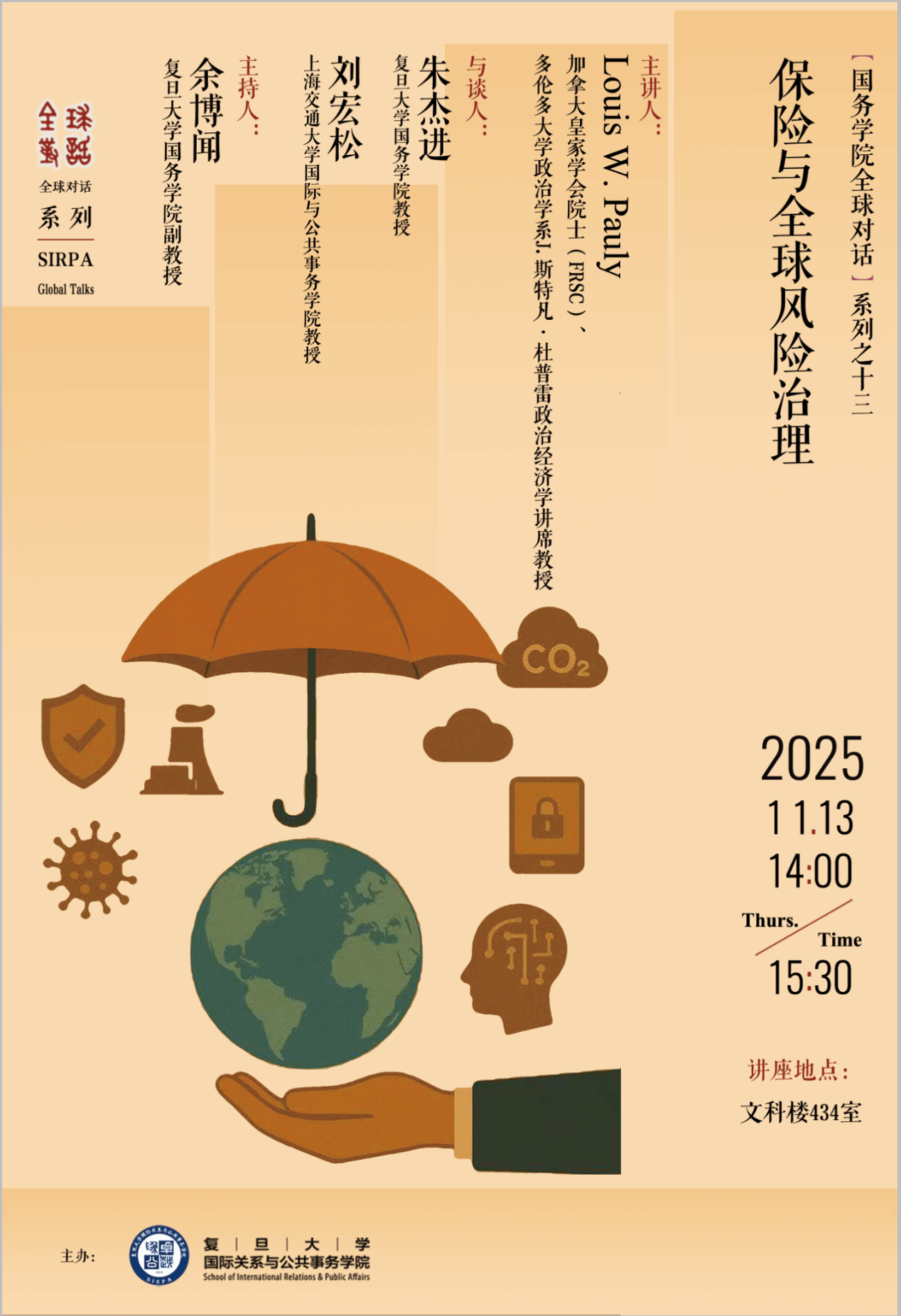
Modern insurance practices emerged 500 years ago, just after the discovery of risk and the invention of probabilistic calculation. Over time, they succeeded in fostering societal resilience at ever higher levels of aggregation by spreading the burdens of economic loss, mobilizing capital for rebuilding after disasters, and stimulating innovations aimed at preventing future losses. The modern state emerged simultaneously. As states became ever more enmeshed through dynamic markets, insurance and reinsurance practices harnessed collaborative impulses to serve public purposes, eventually covering an expansive array of border-spanning challenges. They facilitated more accurate assessments of specific risks and prompted novel experiments in emergency management and disaster prevention. Today, their prospects for success often depend on entangled decisions by private and public actors as well as on the attractiveness of justifying metaphors. Their character varies with the complexity of the risks being confronted across different time horizons as well as with the depth of the uncertainty surrounding them. At its core, this paper outlines seminal transnational experiments informed by the logic of insurance—and especially reinsurance—of relevance to contemporary debates on new risks that inevitably cross territorial boundaries. These include the risks of modular nuclear reactors, digital financial instruments, climatic shifts, novel microbes, and technologies reliant on artificial intelligence. Those experiments combine private and public governing capacities and suggest new models for collaboration moving beyond the intergovernmental structures of the post-1919 and post-1945 periods. At a turbulent time, they justify hopes for limited but effective global governance in vital policy arenas. In the end, they underline the profound implications of political enmeshment in a world where some risks are inevitably shared.